
Table of Contents
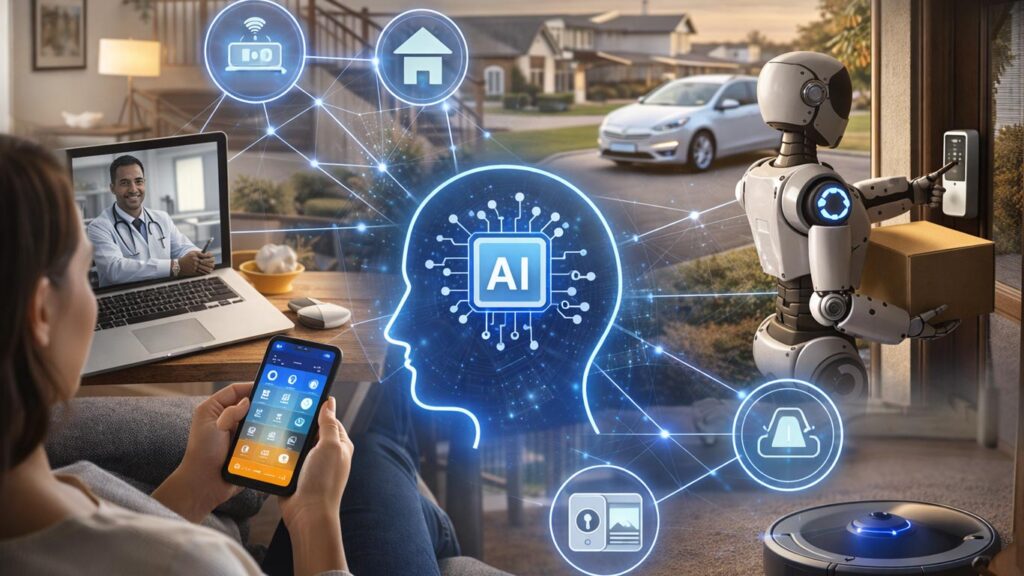
Artificial Intelligence (AI) is no longer a futuristic concept reserved for science fiction movies or research labs. In the United States, AI is already woven into daily routines—from unlocking smartphones with facial recognition to receiving personalized recommendations on streaming platforms. As AI technology advances rapidly, its influence on everyday American life is expected to grow even deeper over the next decade.
In this detailed guide, we explore how AI is shaping homes, workplaces, healthcare, education, transportation, and more—and what the future may look like as intelligent systems become even more integrated into society.
What Is Artificial Intelligence?
Artificial Intelligence refers to computer systems designed to perform tasks that typically require human intelligence. These tasks include:
- Learning from data
- Recognizing patterns
- Understanding speech
- Making decisions
- Solving complex problems
AI systems use technologies such as machine learning, natural language processing, and computer vision to function effectively.
Major technology companies like Google, Microsoft, Amazon, and Apple are investing billions of dollars into AI research and development.
AI in American Homes
1. Smart Assistants
Voice assistants such as Amazon Alexa, Google Assistant, and Siri already help millions of Americans manage daily tasks.
In the future, these assistants will:
- Understand context better
- Anticipate user needs
- Automate entire household routines
- Provide advanced home security monitoring
Instead of reacting to commands, AI assistants may proactively suggest actions, such as adjusting thermostats based on weather forecasts or reminding users about important health appointments.
2. Smart Appliances and Energy Efficiency
AI-powered smart thermostats, lighting systems, and refrigerators are becoming more intelligent.
Future AI systems may:
- Predict energy consumption patterns
- Automatically reduce waste
- Integrate seamlessly with renewable energy sources
- Optimize home battery storage systems
This could significantly lower energy costs for American households.
AI in Healthcare
Healthcare is one of the sectors expected to benefit most from AI innovation.
1. Early Disease Detection
AI algorithms can analyze medical images, lab results, and patient history faster than traditional systems. In the future, AI may detect diseases such as cancer or heart conditions earlier and more accurately.
2. Personalized Treatment Plans
AI systems can analyze large datasets to recommend tailored treatment options based on genetics, lifestyle, and medical history.
3. Remote Monitoring
Wearable devices powered by AI will monitor vital signs in real time and alert healthcare providers if abnormalities occur.
This advancement could reduce hospital visits and improve patient outcomes across the United States.
AI in Education
AI is reshaping how students learn and how teachers manage classrooms.
Personalized Learning
Future AI platforms may:
- Adapt lesson difficulty automatically
- Identify learning gaps
- Provide real-time tutoring
- Offer language translation support
Students could receive customized learning paths based on their strengths and weaknesses.
Administrative Efficiency
AI can automate grading, attendance tracking, and administrative tasks, allowing educators to focus more on teaching.
AI in the Workplace
The American workforce is undergoing transformation as AI becomes more capable.
1. Automation of Routine Tasks
AI systems can automate repetitive tasks in:
- Data entry
- Customer service
- Manufacturing
- Accounting
This improves efficiency but also raises concerns about job displacement.
2. AI as a Productivity Partner
Rather than replacing jobs entirely, AI will likely assist professionals by:
- Generating reports
- Analyzing data
- Suggesting improvements
- Enhancing decision-making
For example, AI-powered tools can draft emails, summarize meetings, and provide predictive analytics for businesses.
AI in Transportation
Self-driving vehicles represent one of the most visible examples of AI innovation.
Autonomous systems use AI to:
- Detect road conditions
- Recognize traffic signs
- Avoid collisions
- Communicate with other vehicles
While fully autonomous cars are still developing, driver-assistance features powered by AI are already common in American vehicles.
AI could also improve traffic flow in cities by optimizing traffic signals and reducing congestion.
AI and Financial Services
AI is transforming banking and financial management.
Fraud Detection
Banks use AI to monitor suspicious activity and prevent fraud in real time.
Personalized Financial Advice
AI-powered financial tools can:
- Analyze spending habits
- Suggest budgeting strategies
- Recommend investment options
This makes financial planning more accessible to everyday Americans.
AI in Retail and Entertainment
From online shopping to streaming platforms, AI already influences consumer behavior.
Future developments may include:
- Hyper-personalized shopping experiences
- AI-powered virtual fitting rooms
- Real-time inventory management
- Advanced content recommendations
Streaming platforms use AI to recommend movies and shows based on viewing history, and this personalization will only become more precise.
Ethical and Privacy Concerns
While AI offers significant advantages, it also raises important questions.
Data Privacy
AI systems rely on large datasets, which often include personal information. Protecting user data is critical.
Bias in Algorithms
AI models can reflect biases present in their training data. Ensuring fairness and transparency will be a major challenge.
Job Displacement
Automation may reduce demand for certain jobs. Policymakers and businesses must focus on reskilling and workforce adaptation.
Government and Regulation
The U.S. government is actively discussing AI regulations to ensure:
- Transparency
- Accountability
- Ethical development
- National security protection
Balancing innovation with responsible oversight will shape the future of AI adoption.
AI and Cybersecurity
As AI becomes more widespread, cybersecurity will become even more important.
AI can:
- Detect cyber threats faster
- Monitor unusual network activity
- Prevent data breaches
However, cybercriminals may also use AI to develop more sophisticated attacks. This ongoing digital arms race will influence how secure future systems become.
The Long-Term Outlook
Over the next decade, AI may become as essential as electricity or the internet.
We can expect:
- AI-powered smart cities
- Autonomous public transportation
- Advanced healthcare diagnostics
- Fully integrated smart homes
- AI-driven environmental monitoring
Rather than replacing human intelligence, AI is more likely to augment it—helping individuals make better decisions and improving overall efficiency.
Conclusion
Artificial Intelligence is already reshaping everyday American life, and its influence will only expand in the coming years. From healthcare and education to transportation and entertainment, AI is transforming how people live, work, and interact with technology.
While challenges such as privacy, bias, and job displacement must be addressed responsibly, the potential benefits of AI are enormous. As innovation continues and regulations evolve, AI will likely become an invisible yet powerful force supporting daily activities across the United States.
The future of AI is not just about smarter machines—it is about creating smarter systems that enhance human life in meaningful and responsible ways.
Short on time?
Use our AI tool to summarize this article in seconds.
You might also be interested in
Edge Computing Explained: Why It Matters for the Future of the Internet
February 24, 2026
How Blockchain Technology Is Being Used Beyond Cryptocurrency
February 23, 2026
5G Technology in the United States: Benefits, Risks, and Future Outlook
February 21, 2026
The Rise of Smart Homes in America: Devices That Are Changing Daily Life
February 19, 2026