
Table of Contents
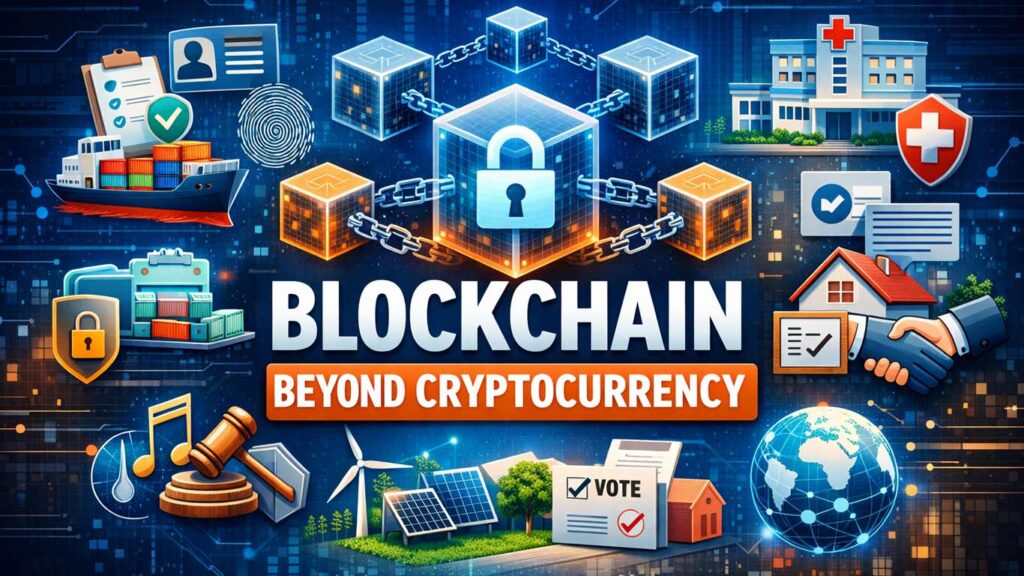
When most people hear the word “blockchain,” they immediately think of cryptocurrencies like Bitcoin. While digital currencies helped bring blockchain into the spotlight, the technology itself is far more versatile. Today, organizations across the United States and around the world are exploring blockchain for applications that go well beyond digital money.
From supply chain transparency to digital identity systems, blockchain is quietly transforming industries. In this article, we will explore what blockchain is, how it works in simple terms, and the real-world ways it is being used beyond cryptocurrency.
What Is Blockchain Technology?
At its core, blockchain is a decentralized digital ledger. Instead of storing information in a single central database, blockchain distributes data across a network of computers. Each transaction or data entry is grouped into a “block,” and these blocks are linked together in chronological order, forming a “chain.”
Key characteristics of blockchain include:
- Decentralization – No single authority controls the entire network.
- Transparency – Transactions can be visible to participants.
- Immutability – Once data is recorded, it is extremely difficult to alter.
- Security – Advanced cryptographic techniques protect data integrity.
While cryptocurrencies such as Bitcoin use blockchain to record financial transactions, the underlying technology can securely store many other types of information.
1. Supply Chain Management
One of the most promising uses of blockchain is in supply chain tracking.
In traditional supply chains, data is often fragmented across multiple systems. This can lead to delays, fraud, and lack of transparency. Blockchain provides a shared, tamper-resistant ledger where every step of a product’s journey is recorded.
How It Helps:
- Tracks products from manufacturer to retailer
- Reduces counterfeit goods
- Improves recall efficiency
- Enhances consumer trust
For example, companies like IBM have developed blockchain-based supply chain platforms that allow businesses to trace food products in seconds rather than days. In industries like pharmaceuticals and agriculture, this can significantly improve safety and compliance.
2. Healthcare Data Management
Healthcare systems in the United States face challenges such as fragmented patient records, privacy concerns, and data breaches.
Blockchain can create secure, interoperable health record systems where patients control access to their data.
Potential Benefits:
- Secure sharing of medical records
- Reduced fraud in insurance claims
- Improved accuracy in clinical trials
- Enhanced patient privacy
By using blockchain, hospitals and clinics could access verified patient information instantly, while patients maintain control over who sees their data. This model reduces administrative costs and increases trust between providers and patients.
3. Digital Identity Verification
Identity theft remains a major issue in the United States. Traditional identity systems rely heavily on centralized databases, which are vulnerable to hacking.
Blockchain enables self-sovereign identity, meaning individuals own and control their digital identity credentials.
Use Cases:
- Online banking verification
- Government ID systems
- Secure login authentication
- Border control processes
Instead of repeatedly submitting sensitive personal information, users could share verified digital credentials stored securely on a blockchain. This reduces the risk of identity theft and data breaches.
4. Smart Contracts in Business
Smart contracts are self-executing contracts written in code. They automatically enforce the terms of an agreement once predefined conditions are met.
Blockchain platforms like Ethereum allow developers to build decentralized applications (dApps) that use smart contracts.
Business Applications:
- Real estate transactions
- Insurance claim processing
- Automated payroll systems
- Vendor agreements
For example, in real estate, once payment is confirmed, ownership records can automatically transfer without the need for lengthy paperwork. This reduces transaction costs and speeds up processes.
5. Voting Systems and Election Integrity
Election security is a topic of growing importance. Blockchain-based voting systems could improve transparency and trust in elections.
Advantages:
- Tamper-resistant vote recording
- Transparent audit trails
- Faster vote counting
- Reduced fraud risks
While large-scale implementation is still being studied, blockchain voting pilots have demonstrated potential in secure remote voting systems. Such systems could benefit military personnel stationed abroad and voters in remote areas.
6. Intellectual Property Protection
Digital content creators often struggle with copyright infringement and royalty tracking. Blockchain can create a permanent record of content ownership.
How It Works:
- Artists register their work on a blockchain
- Ownership timestamps are recorded
- Royalty payments can be automated through smart contracts
This ensures creators are fairly compensated when their work is used. In industries like music, publishing, and digital art, blockchain helps protect intellectual property rights.
7. Financial Services Beyond Crypto
While cryptocurrencies dominate headlines, blockchain is also transforming traditional financial services.
Major financial institutions are exploring blockchain for:
- Cross-border payments
- Trade finance
- Fraud prevention
- Settlement systems
For instance, companies like JPMorgan Chase have developed blockchain-based payment networks to enable faster and more secure transactions. These systems reduce settlement times from days to minutes.
8. Real Estate Transactions
Buying or selling property involves paperwork, intermediaries, and lengthy verification processes. Blockchain can streamline these transactions by digitizing property records.
Benefits:
- Reduced fraud
- Faster title verification
- Lower transaction costs
- Increased transparency
Property ownership data stored on blockchain cannot be easily altered, reducing disputes and improving trust between buyers and sellers.
9. Energy and Sustainability
Blockchain is being used to track renewable energy production and carbon credits.
In energy markets:
- Consumers can trade excess solar energy
- Companies can verify carbon offset credits
- Renewable energy usage can be transparently tracked
This technology supports sustainability efforts and encourages responsible energy consumption.
10. Government Record Keeping
Governments manage massive amounts of data, including land records, licenses, and permits. Blockchain can modernize public record systems.
Potential Improvements:
- Reduced administrative corruption
- Faster processing of applications
- Improved transparency
- Secure record storage
By digitizing and decentralizing records, governments can improve efficiency and reduce costs over time.
Challenges Facing Blockchain Adoption
Despite its potential, blockchain adoption faces obstacles:
- Scalability limitations
- Regulatory uncertainty
- High implementation costs
- Energy consumption concerns
- Lack of technical expertise
In the United States, regulatory clarity will play a major role in determining how quickly blockchain expands beyond cryptocurrency applications.
The Future of Blockchain Technology
Blockchain is evolving from a cryptocurrency backbone into a foundational digital infrastructure technology.
As businesses seek greater transparency, security, and efficiency, blockchain solutions are becoming increasingly attractive. Whether in healthcare, supply chain, finance, or identity management, the technology’s decentralized structure offers powerful advantages.
Over the next decade, blockchain may become as essential as cloud computing is today. Organizations that understand and adopt blockchain responsibly could gain significant competitive advantages.
Conclusion
Blockchain technology is far more than the engine behind cryptocurrencies. Its ability to provide secure, transparent, and decentralized data management makes it suitable for a wide range of industries.
From supply chains and healthcare to voting systems and smart contracts, blockchain is reshaping how information is stored and verified. While challenges remain, the technology’s potential to improve efficiency, reduce fraud, and enhance trust makes it one of the most important innovations of the digital age.
As adoption grows across the United States, blockchain is likely to move from an emerging trend to a core component of modern digital infrastructure.
Short on time?
Use our AI tool to summarize this article in seconds.
You might also be interested in

The Future of Artificial Intelligence in Everyday American Life
February 25, 2026
Edge Computing Explained: Why It Matters for the Future of the Internet
February 24, 2026
5G Technology in the United States: Benefits, Risks, and Future Outlook
February 21, 2026
The Rise of Smart Homes in America: Devices That Are Changing Daily Life
February 19, 2026